Chapter 6: Rollups
Introduction
Rollups move transaction execution away from the base chain while using it for settlement and data. Hundreds or thousands of transactions are compressed into a batch. The rollup publishes a new state commitment and enough information for the base layer to enforce correctness.
This design separates three questions: who orders transactions, who executes them, and how the result is proven. Understanding that separation is more useful than memorizing project names.
Rollups From First Principles
A rollup moves transaction execution away from the base chain while keeping a base-chain contract able to check and enforce the result. Many transactions are collected into a batch. The rollup executes them, calculates a new state root, and posts data plus a claim about that new state.
Picture an accountant processing a box of receipts. Re-entering every receipt in the public ledger is expensive. Instead, the accountant publishes the receipts in a compact form, a new total, and evidence that the arithmetic follows the agreed rules. Anyone can reconstruct the work or check the evidence. The base chain acts as the final court and asset custodian.
The roles
- The sequencer receives transactions and chooses their order. It gives fast responses but may be able to delay or censor users.
- The batcher compresses and publishes ordered transaction data.
- An executor runs the rollup program and calculates state changes.
- A prover creates cryptographic evidence for a validity rollup.
- A challenger checks optimistic claims and starts a dispute when one is invalid.
- The settlement contract stores accepted commitments and applies proof or dispute rules on L1.
- The canonical bridge locks assets on one layer and releases or represents them on the other according to the settlement contract.
One operator can initially run several roles. Keeping the names separate shows which power must later be decentralized and which failure caused a delay.
Optimistic and validity proofs
An optimistic rollup treats a posted state claim as acceptable if nobody successfully challenges it before a deadline. "Optimistic" means the normal path assumes the claim will not need a dispute; it does not mean users trust the operator without evidence.
A fault proof demonstrates that a claimed transition was invalid. Interactive systems narrow a disagreement over a long execution trace until the base chain checks one small step. This resembles two people disputing a long spreadsheet by repeatedly identifying which half contains the first wrong row.
A validity rollup requires a cryptographic proof before accepting the new state. A validity proof convinces a verifier that the encoded program transformed the committed input state into the claimed output state. A zero-knowledge proof can additionally hide private witness data, but not every validity proof uses privacy.
Data is separate from correctness
A proof may show that a calculation was correct without giving users the inputs needed to reconstruct balances or make future transactions. Data availability asks whether those inputs can actually be obtained.
Rollups commonly publish compressed transaction data to L1 or a specified DA layer. A blob is a temporary, separately priced L1 data container designed for rollup batches. The chain commits to blob contents and makes them available for a protocol retention period; long-term archives are a separate service.
Deposits and withdrawals
A deposit locks an L1 asset in the bridge and creates a message the rollup must process. A withdrawal begins on L2, becomes part of an accepted state root, and then proves to the L1 bridge that the message is valid and unused.
Optimistic withdrawals wait through the challenge period because releasing an asset too early could honor an invalid state claim. Validity withdrawals do not need that optimistic challenge window, but they still wait for proof generation and acceptance, the deployment's settlement-contract stages and security delays, and the required L1 finality. Both designs need replay protection: each withdrawal identifier can be consumed only once.
Forced inclusion and escape
If a sequencer ignores a user, a forced-inclusion inbox lets the user submit through L1. The protocol specifies how soon the rollup must process that message. An escape hatch lets users recover or advance state without the normal operator under defined failure conditions.
These mechanisms matter only when tested. A contract entry point that requires unavailable data, unaffordable gas, or an active operator is not an effective escape.
Reading rollup status
A wallet can truthfully show several stages:
- received by the sequencer;
- ordered in an L2 block;
- batch data published;
- state claim submitted;
- proof accepted or challenge period complete;
- containing L1 block final;
- withdrawal executed.
Later sections use "unsafe," "safe," "accepted," and "final" for these boundaries. The exact labels vary by implementation; the evidence behind the label is what matters.
The Rollup Lifecycle
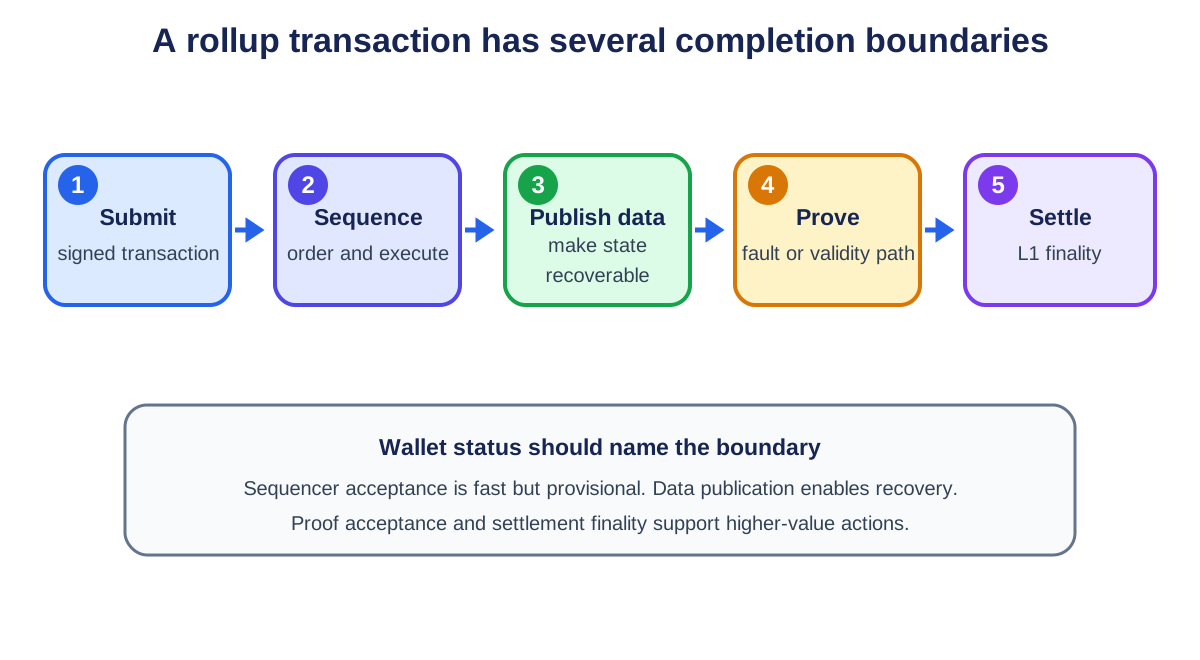
Figure 6.1: A rollup transaction moves through sequencing, data publication, proof, and settlement. Applications should name which boundary they treat as complete. Original figure for this book.
A typical transaction follows this path:
- a user signs and submits a transaction to a sequencer;
- the sequencer orders transactions and produces an L2 block;
- an executor computes the new rollup state;
- batch data or a data commitment is posted;
- a state root is submitted to the settlement contract;
- a validity proof is accepted, or an optimistic assertion survives the challenge process under its honest-challenger and data assumptions;
- the settlement transaction reaches the required L1 finality.
The sequencer provides fast inclusion and a useful user experience, but its acknowledgement is normally soft confirmation. Settlement finality comes later. A centralized sequencer can censor or reorder transactions even when it cannot steal funds. Force-inclusion mechanisms and sequencer decentralization address this liveness risk.
Named Case Study: Arbitrum Nitro and BoLD
Deployment label: production. Arbitrum One runs the Nitro stack as an optimistic rollup. Its official documentation separates the fast path through a sequencer from the enforceable path through Ethereum, and describes BoLD as the dispute protocol used to resolve competing state claims.1 [^4]2 The distinction is the useful lesson: an optimistic rollup is not secured by optimism. It is secured by data that validators can replay, a state-transition program they agree to run, and a bounded route for rejecting a false claim.
Architecture: four boundaries, not one chain
Nitro can be read as four connected systems. The sequencer accepts transactions, chooses an order, executes that order, and broadcasts a feed that gives applications a fast soft confirmation. The batch poster compresses the ordered data and sends it to Ethereum, normally using EIP-4844 blobs and with calldata as an alternative path described by the protocol documentation. Ethereum's Sequencer Inbox establishes the canonical data sequence. Nitro nodes read that sequence and execute the same state-transition function. Finally, validators make and check assertions about the resulting state; BoLD resolves a disagreement by reducing it until Ethereum can judge the disputed execution.
This architecture creates several clocks. A wallet may see a sequencer receipt in seconds, while the batch is not yet on Ethereum. After publication, the transaction has stronger data availability, but a state assertion may still be disputable. A canonical L2-to-L1 withdrawal becomes executable only after the assertion supporting it is confirmed under the dispute rules and the required Ethereum conditions are met. Calling every one of these states "final" hides the exact risk the user is taking.
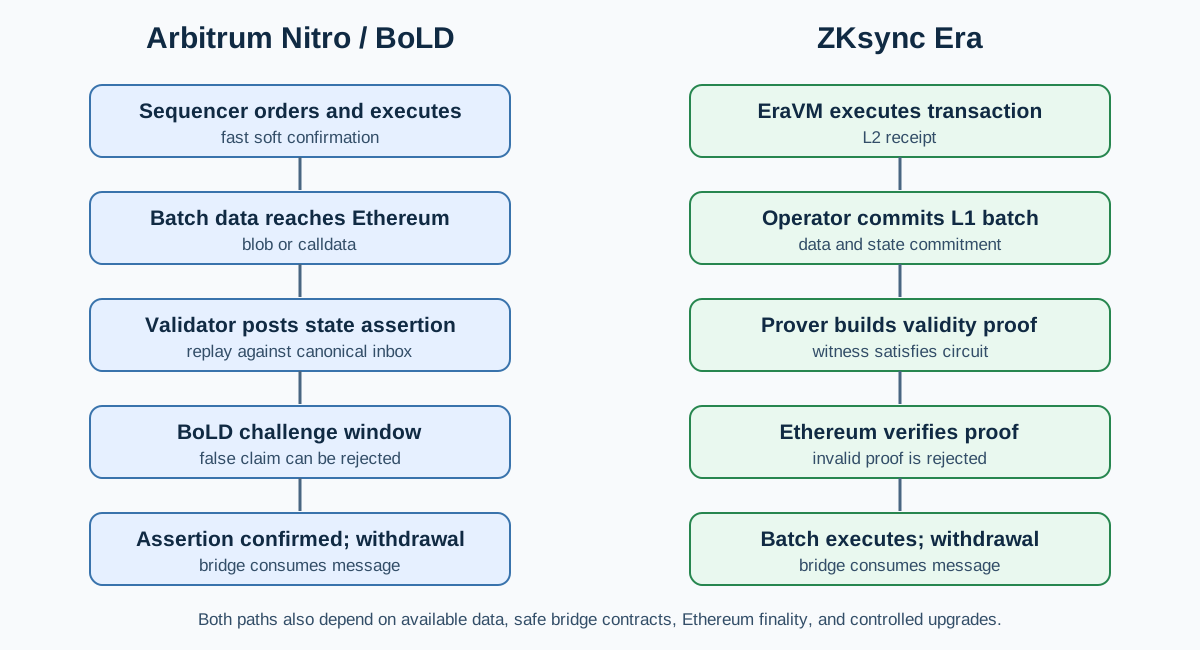
Figure 6.2: Named production rollups use different correctness paths after sequencing and data publication. Original figure for this book.
Trace: deposit, transfer, publication, dispute, withdrawal
Suppose Lina moves 1 ETH from Ethereum to Arbitrum One, pays a merchant on Arbitrum, and later withdraws the remaining ETH.
1. Deposit. Lina's Ethereum transaction calls the canonical bridge. The L1 contract escrows the asset and places an L1-to-L2 message into Arbitrum's delayed message path. This is not an ordinary transfer to a second custodian. The L1 event becomes an input that Nitro must consume in canonical order. After the message is included and executed on L2, the corresponding balance is created for Lina under the bridge rules. The L1 transaction can be reorganized before Ethereum finality, so software should retain the source transaction and report whether the deposit is merely observed, included, or final enough for its policy.
2. Sequencing and execution. Lina signs the merchant payment and sends it to an Arbitrum RPC endpoint. The sequencer checks the transaction, orders it, executes it with the Nitro state-transition function, and emits a sequencer-feed result. The merchant can treat that result as a low-latency promise, but it is not an Ethereum settlement guarantee. A sequencer can delay or reorder a transaction, and a feed result can precede canonical batch publication.1 3
3. Data publication. The batch poster compresses the chosen sequence and submits it to the Sequencer Inbox on Ethereum. Nitro documentation describes blob publication through addSequencerL2BatchFromBlobs and calldata publication through addSequencerL2Batch.4 Once the batch is in the canonical inbox, an independent Nitro node can recover the same ordered input and reproduce execution. Publication therefore changes what observers can verify: before it, they mainly have the sequencer's promise; after it, they have Ethereum-ordered data from which to derive the L2 state.
4. Assertion and BoLD. A proposer posts an assertion about a state reached after executing the inbox. An honest validator replays the input and compares the result. If a conflicting or false assertion appears, BoLD lets participants challenge it. The dispute does not ask Ethereum to re-execute the whole rollup history. Parties commit to execution history, narrow the disagreement, and ultimately reach a small step that the on-chain verifier can decide. BoLD is designed so that an attacker cannot extend dispute resolution without bound merely by creating more conflicting claims; honest parties still need the data, software, capital for required bonds, and operational ability to act within protocol deadlines.2
5. Withdrawal. Lina initiates an L2-to-L1 message that burns or locks the L2 representation and names the L1 recipient and amount. That message is included in L2 state and supported by a state assertion. The canonical bridge must wait until the assertion is confirmed under the rollup's dispute rule before releasing escrowed ETH on Ethereum. A liquidity bridge may pay Lina sooner, but that is a separate market transaction with liquidity, pricing, and counterparty assumptions. It does not shorten the canonical security path.
Trust and upgrade assumptions
Nitro limits what a faulty sequencer can do, but it does not make the sequencer irrelevant. The sequencer controls the fast ordering path and can temporarily censor or delay users. Arbitrum exposes a Delayed Inbox path on Ethereum. Official documentation states that a user can bypass the sequencer and that delayed messages can eventually be force-included after the protocol delay.3 This is censorship resistance with latency and L1 gas cost, not instantaneous inclusion.
Correctness also depends on at least one capable honest validator monitoring assertions and being able to complete a dispute. Users depend on Ethereum for ordering, contract execution, and finality, and on available batch data for replay. They also depend on the deployed contracts, the Nitro program identified by the dispute machinery, and the governance and upgrade controls that can change those components. BoLD reduces one class of permission and delay risk. It does not remove contract bugs, implementation bugs, compromised upgrade keys, Ethereum failure, or the operational risk that nobody runs an effective validator.
The practical audit question is therefore broader than "does Arbitrum have fraud proofs?" It is: which contracts and program versions define a valid state, who can replace them, what delay precedes a replacement, can users exit during that delay, and which emergency body can intervene? Those facts can change, so a deployment review should read the live contracts and current governance documentation rather than copy a static decentralization label from this book.
Observable consequences and failure path
The layered design is visible. A block explorer or node can distinguish a transaction seen in the sequencer feed from one whose batch data is on Ethereum. An operator can measure the age of the oldest unpublished sequence, the delayed-inbox cursor, assertion status, and dispute activity. A wallet can tell Lina why a withdrawal is waiting instead of displaying one spinner.
Now let the sequencer stop after giving Lina a receipt but before publishing her payment. The payment may be visible on the feed yet absent from the canonical inbox. Lina or her wallet resubmits through the L1 delayed path. She pays Ethereum gas and waits through the inclusion delay, but the sequencer cannot turn its outage into a permanent veto. If, instead, the batch is published and a proposer asserts a state that omits or misexecutes the payment, an honest validator reconstructs the state and challenges the assertion through BoLD. The bad assertion must not become the basis for Lina's canonical withdrawal. If no capable honest validator acts before the applicable deadline, the optimistic safety assumption has failed even though the protocol had a dispute contract.
That last distinction is the transferable lesson. A sequencer failure is primarily a liveness and user-experience event when forced inclusion works. An unchallenged invalid assertion is a correctness failure. Missing data can make a challenge impossible. A malicious upgrade can change the rules by which every later state is judged. Each failure reaches a different boundary and needs a different alarm and recovery procedure.
Named Case Study: ZKsync Era's Validity Pipeline
Deployment label: production. ZKsync Era is a validity rollup whose protocol documentation describes a three-stage batch lifecycle on Ethereum: a batch is committed, proved, and executed. Its L1-to-L2 communication path treats deposits and other priority operations as messages that the L2 bootloader must process, while its proof system lets Ethereum verify a batch transition without replaying EraVM execution.5 6
Architecture: execution, data, proof, and bridge
A ZKsync transaction first runs under EraVM, with system contracts and the bootloader enforcing protocol rules. A sequencer forms L2 blocks and groups them into L1 batches. For rollup-mode operation, the operator publishes the information required by the protocol's data-availability rule and commits the batch metadata on Ethereum. A prover constructs a validity proof for the batch transition. Ethereum contracts verify the proof and later execute the batch, which makes its L2-to-L1 messages available to the bridge contracts under the protocol rules.
"Execute" is easy to misunderstand here. It does not mean Ethereum reruns every user transaction. User computation already ran on L2 and was covered by the proof. The L1 execution stage advances the settlement contracts after the commitment and proof checks, and permits effects such as finalized withdrawals. Separating commit, prove, and execute makes failure diagnosis much sharper than one "pending" status.
Trace: priority deposit, Era payment, proof, and exit
Suppose Lina deposits 1 ETH into ZKsync Era, makes an EraVM payment, then withdraws what remains.
1. L1 priority operation. Lina sends an Ethereum transaction to the canonical bridge. The L1 contract escrows ETH and creates an L1-to-L2 transaction, also called a priority operation. The request carries the target, value, gas-related parameters, refund recipient, and data needed for L2 execution. ZKsync's documented communication flow passes the operation into the L2 bootloader rather than letting the sequencer silently invent the deposit.6 The same channel is used for protocol upgrade transactions, which is a reminder that system changes and user deposits both need explicit cross-layer ordering.
2. L2 execution. The bootloader processes the priority operation and the deposit is reflected in Era state. Lina then signs the merchant payment and submits it through an RPC endpoint. A successful sequencer response tells her the transaction ran in an L2 block. It does not yet prove that Ethereum has accepted the containing L1 batch. Applications should expose at least the distinction between L2 execution, batch commitment, proof verification, and L1 execution.
3. Batch commitment and data publication. The operator collects L2 blocks into an L1 batch and submits a commitment transaction to Ethereum. The commitment binds the previous and new state information and the public data needed by the protocol. An independent observer can associate Lina's transaction with its L2 block and L1 batch, then identify the Ethereum commitment transaction. If the operator stops before commitment, Lina has an L2 receipt without the strongest settlement evidence.
4. Proof. The proving pipeline builds a witness for the EraVM transition and produces a validity proof. Ethereum's verifier checks the proof against public inputs tied to the batch commitment. If the witness does not satisfy the circuit or the public inputs do not match, a sound verifier rejects the proof. Unlike an optimistic rollup, Era does not make users wait to see whether someone challenges an accepted invalid transition. The cost moves into circuit correctness, witness generation, prover availability, verifier correctness, and upgrade control.
5. Batch execution and withdrawal. After the proof is accepted, the L1 contracts execute the batch under the protocol sequence. Lina's later L2 withdrawal creates an L2-to-L1 message. Once the batch containing that message has reached the required L1 stage, she finalizes the withdrawal through the L1 bridge. ZKsync documents warn that withdrawals may experience an additional delay as a security measure; software should read the live status rather than promise that every validity-rollup withdrawal is immediate.7
Trust and upgrade assumptions
A validity proof prevents a transition outside the proved rules from being accepted, assuming the proof system, circuit, verifier contract, and cryptographic assumptions are sound. It does not prove that the sequencer included Lina promptly, that the user interface showed the right recipient, or that an upgrade is benign. It also does not create data availability by itself. Users need the data path specified by the deployment to reconstruct state and prepare transactions.
Prover failure is normally a liveness failure: an unproved batch cannot advance through the settlement pipeline, but a prover should not be able to make Ethereum accept an arbitrary state without a valid proof. This makes prover diversity and recovery important even when the prover is not trusted for correctness. Sequencer and operator failures can delay inclusion, publication, proofs, and withdrawals. The bridge and system contracts remain high-value code. Upgrade transactions are especially important because a new verifier, bootloader, system-contract set, or circuit version can change what later proofs mean. ZKsync's L1-to-L2 documentation explicitly gives upgrade transactions a defined initiation, bootloader, commit, possible revert, and execute lifecycle.6
A deployment assessment should therefore identify who can authorize an upgrade, which delay and emergency powers apply, how old and new proof versions overlap, and whether a user has a usable exit path before the new rules take effect. "Validity proved" describes a batch relative to a program. It does not answer who chose that program.
Observable consequences and failure path
The pipeline leaves concrete evidence: Lina's L2 receipt names a block; the block maps to a batch; Ethereum records the batch commitment, proof verification, and execution transactions; the bridge records whether her withdrawal message has been consumed. Operators can publish queue ages for uncommitted, unproved, and unexecuted batches. A long unproved queue points toward witness or prover trouble. A long committed but unexecuted queue points toward a later settlement stage. Those are different incidents even if both appear to a user as a delayed withdrawal.
Now let the primary prover fail after a batch is committed. The correct response is not to bypass proof verification. The batch remains unproved while another prover reconstructs the witness and submits a proof. Lina's prior accepted balance remains safe under the assumed contract rules, but her withdrawal cannot complete on schedule. If the circuit contains a bug that accepts an invalid transition, proof verification can succeed while the economic state is wrong; validity systems move much of the correctness burden into circuit and verifier engineering. If an authorized upgrade installs a faulty verifier, governance has changed the proof boundary itself. And if batch data required for reconstruction is unavailable, users may be unable to independently derive the state even though a proof attests to the transition.
The comparison with Nitro is now precise. Nitro needs an honest, timely challenge to reject a false assertion. Era needs a sound proof system and verifier to prevent one from being accepted. Both need ordered cross-layer messages, available data, safe contracts, transparent upgrade control, and a user-visible account of where a transaction sits.
Production Rollup Comparison on One Payment-and-Withdrawal Workload
The table fixes the workload: deposit ETH from Ethereum, make one L2 payment, publish the batch data required by the named deployment, establish state correctness, and withdraw canonically to Ethereum. "Production" means the named public deployment is live; it does not claim that every decentralization or governance goal is complete. OP Mainnet and Base share the OP Stack family but are separate deployments with separate operators and governance contexts.8
| Deployment | Execution and ordering | Data and correctness path | Canonical withdrawal boundary | Main failure or control to inspect |
|---|---|---|---|---|
| Arbitrum One (Nitro/BoLD) | Nitro execution; fast sequencer feed, with an L1 delayed path for bypass and force inclusion | Ordered batches reach Ethereum by blobs or calldata; validators replay Nitro and BoLD adjudicates disputed assertions | Supporting assertion confirmed after the optimistic dispute process, then L1 bridge execution | Sequencer delay, effective validator participation and bonds, Nitro/dispute-contract versions, governance and upgrade powers |
| OP Mainnet (OP Stack) | OP Stack sequencer produces L2 blocks; derivation reconstructs L2 from Ethereum data | Output claims are challengeable through the OP fault-proof system; Ethereum data drives derivation | Withdrawal is initiated on L2, proved against an output, waits through the applicable finalization period, then is finalized on L1 | Sequencer/proposer liveness, fault-proof configuration, guardian and upgrade powers, portal implementation9 |
| Base (OP Stack) | OP Stack execution and sequencing operated for Base | Same broad OP derivation and fault-proof architecture, with deployment-specific contracts and controls | Same initiate-prove-finalize shape through the deployment's canonical bridge | Do not infer Base's live security configuration solely from OP Mainnet; inspect Base's contracts, operators, and current stage |
| ZKsync Era | EraVM, bootloader, sequencer, L2 blocks grouped into L1 batches | Rollup data path plus commit-prove-execute pipeline; Ethereum verifies a validity proof | Batch containing the L2-to-L1 message reaches required proof/execution stage, then bridge finalization; a security delay may apply | Circuit/verifier correctness, prover liveness, operator queues, system-contract and upgrade controls |
| Starknet | Starknet sequencer orders and executes Cairo transactions; transaction receipts expose staged status | State updates are proved through Starknet's proving pipeline, including SHARP aggregation, and verified on Ethereum | StarkGate releases after the relevant state/message is accepted and the bridge conditions are met | Sequencer and prover liveness, Cairo/prover/verifier versions, data reconstruction, messaging and upgrade controls10 11 |
| Scroll | EVM-compatible L2 execution; blocks are grouped into chunks and batches | Scroll documents execution, batch/data commitment, proof generation, and finalization; a commit transaction records batch data and a finalize transaction verifies proof and advances finalized state | Withdrawal message becomes finalizable after the containing batch is finalized and gateway checks pass | Sequencer/batcher/prover liveness, codec and circuit compatibility, gateway contracts, upgrade control12 13 |
The table should not be used to rank systems by one label. It is a checklist of where to look. For example, two validity rollups may use different virtual machines, proof aggregation, data encodings, upgrade authorities, and withdrawal delays. Two OP Stack chains may share software while exposing different operational and governance risk. The useful comparison holds the user action constant and follows the evidence all the way from a signature to asset release.
Optimistic Rollups
Optimistic rollups assume a proposed state is valid unless someone proves otherwise. After a batch is posted, a challenge period allows a verifier to submit a fraud proof.
A modern fault-proof system narrows disagreement to a specific execution step, then asks Layer 1 to evaluate that step. This avoids re-executing an entire batch on-chain.
Benefits
- close compatibility with the EVM;
- relatively simple proving assumptions;
- computation is performed off-chain unless disputed;
- mature developer tooling and ecosystems.
Trade-Offs
- canonical withdrawals can wait through the challenge period;
- at least one honest party must be able to reconstruct and challenge bad state;
- the fault-proof implementation and upgrade mechanism are security-critical;
- fast third-party bridges add liquidity and counterparty risk.
The honest verifier requirement does not mean every user must personally watch the chain. It means the system needs an open, economically sustainable set of watchers with access to the data and a working dispute path.14
Validity Rollups
Validity rollups, often called ZK rollups, attach a succinct proof that the new state was computed correctly. The Layer 1 verifier checks the proof rather than replaying the entire batch.
The proof may use a SNARK (succinct non-interactive argument of knowledge) or STARK (scalable transparent argument of knowledge). Both let a verifier check a computation with a proof much smaller than replaying all the work. "Succinct" emphasizes small, cheap-to-check proofs. "Non-interactive" means the final verifier needs one proof rather than a back-and-forth protocol. "Transparent" means the system avoids a secret trusted-setup ceremony. These families differ in proof size, prover cost, verification cost, transparency, and cryptographic assumptions. The phrase "zero knowledge" describes the ability to hide witness data, but a validity rollup can use validity proofs without offering transaction privacy.
Benefits
- invalid state cannot pass the verifier if the proof system and implementation are sound;
- withdrawals do not require a fraud-proof challenge window;
- verification cost can remain small even for a large computation;
- recursive proofs can aggregate many blocks.
Trade-Offs
- proving is computationally demanding;
- circuits or zkVMs add implementation complexity;
- bugs in circuits, verifiers, or trusted setup procedures can be severe;
- EVM equivalence and rapid protocol upgrades are difficult engineering problems.
The course's STARK case study emphasizes scalable proofs: the verifier performs much less work than the prover, making it possible to amortize verification over a batch.
Where the Data Lives
Validity proves that a transition is correct; it does not by itself make the underlying data available.
- A rollup publishes transaction data to the base layer.
- A validium stores data off-chain, often with a data availability committee.
- A volition lets users or applications choose between on-chain and off-chain data.
Validium can reduce cost, but an unavailable committee can prevent users from reconstructing balances or exiting, even if it cannot forge a validity proof. This is why state validity and data availability must be evaluated separately.
Compression and the Cost Model
For many rollups, data publication is the largest variable cost. A batch saves money by:
- removing repeated signature and transaction fields;
- encoding values compactly;
- sharing one Layer 1 transaction across many L2 transactions;
- using blobs rather than expensive EVM calldata where supported.
EIP-4844 introduced blob-carrying transactions with their own fee market. Blobs are committed to by Ethereum consensus and retained for a limited period, which is sufficient for rollup reconstruction and challenges while avoiding permanent EVM storage.15
A rollup's user fee can be viewed as:
L2 execution cost + allocated data-publication cost + proving/operation cost + margin
High batch utilization lowers the data cost per user. Empty blocks or fragmented liquidity reduce those economies of scale.
Bridges and Forced Exits
The canonical bridge locks an asset on Layer 1 and represents it on Layer 2. Withdrawals burn or release the L2 representation and unlock the L1 asset after the required proof or challenge process.
The bridge contract is often the rollup's largest pool of value. Security depends on:
- correct message authentication;
- replay protection;
- the state-root acceptance rule;
- proof verification;
- upgrade and emergency powers;
- a usable escape path if the sequencer stops.
A rollup is not trustless merely because it has a proof system. Users should examine whether contracts are upgradeable, who controls the upgrade keys, whether there is a delay, and whether users can exit before a disputed upgrade takes effect.
Optimistic vs Validity Rollups
| Feature | Optimistic Rollup | Validity Rollup |
|---|---|---|
| Correctness rule | Valid unless challenged | Proof required before acceptance |
| Main proof | Fraud/fault proof | SNARK or STARK |
| L1 computation | Mostly during disputes | Verify each aggregate proof |
| Canonical withdrawal | Delayed by challenge period | After proof and L1 finality |
| Prover burden | Lower in normal operation | Significant and continuous |
| Compatibility | Mature EVM compatibility | zkEVM/zkVM complexity |
| Core assumption | One honest challenger with data | Sound proof system and available data |
Neither design dominates every workload. Optimistic systems benefit from simple execution compatibility. Validity systems benefit from concise finality and proof aggregation. Both still face sequencing, governance, bridging, and data-availability choices.
From Rollups to Appchains
The course asks why applications are becoming chains. A dedicated rollup can choose its fee token, block time, execution environment, governance, and sequencing policy. It can isolate congestion and capture more of the economics generated by its users.
The cost is fragmentation. Users must bridge assets, liquidity is split, and synchronous calls across rollups become asynchronous messages. Superchain and hyperchain designs try to standardize bridges, messaging, and upgrades across related rollups. Shared sequencers and proof aggregation aim to restore some atomicity and economies of scale.
Worked Example: From Transaction to Withdrawal
Assume 1,000 users submit transfers to an optimistic rollup. The sequencer checks signatures and nonces, chooses an order, and returns quick receipts. It executes the batch, produces a new state root, and publishes compressed transaction data to Ethereum. The rollup contract records the proposed root.
A verifier re-executes the data. If its root differs, it opens a dispute. A bisection game narrows the disagreement until the contract checks one disputed machine step. A dishonest proposal is rejected and its bond can be penalized. If nobody challenges during the window, the root becomes final under the rollup contract.
A canonical withdrawal proves that finalized L2 state contains the withdrawal message. A liquidity bridge can pay earlier, but that is a separate service accepting delay and reorganization risk for a fee.
In a validity rollup, a prover generates a proof and the contract verifies it before accepting the root. The user avoids a fault-proof challenge window but may still wait for proving, batch publication, Ethereum inclusion, deployment-specific contract stages or delays, and L1 finality. "Instant finality" must be separated into sequencer confirmation, proof acceptance, and settlement finality.
Sequencer Failure and the Escape Hatch
A sequencer outage should reduce convenience, not destroy ownership. Force inclusion lets a user submit data to Layer 1; after a timeout, the rollup must process it or permit an exit. This path must remain usable when many users need it simultaneously.
Upgrade control is part of the same threat model. If an administrator can replace the verifier immediately, the proof system cannot protect users from that administrator. Delayed upgrades and an exit window make the cryptographic guarantee operationally credible.
Rollup State Commitments and Inboxes
A rollup contract usually maintains an ordered inbox and a sequence of accepted state commitments. The inbox binds the L2 to data posted on L1, including force-included transactions. A simplified commitment might be:
BatchCommitment {
    previous_state_root
    new_state_root
    inbox_start
    inbox_end
    transaction_data_hash
    l2_block_range
}
The transition rule states that executing inbox items and batch data from previous_state_root must produce new_state_root. An optimistic rollup lets a proposer assert this relation subject to challenge. A validity rollup requires a proof of it.
This structure prevents a proposer from proving an arbitrary computation unrelated to user messages. It also lets bridge contracts authenticate an L2 withdrawal against an accepted root.
Interactive Fault Proofs
Re-executing a large batch on Ethereum would remove the scaling benefit. An interactive game instead commits both parties to execution traces. If a trace contains 2^n steps, repeated bisection isolates one disputed step in about n rounds.
Suppose the proposer claims a final machine state and the challenger computes another. They compare a midpoint commitment. Whichever half disagrees becomes the next interval. Eventually the L1 contract executes one instruction against an agreed pre-state and decides which trace is correct.
Implementation details matter:
- the machine state must have a canonical hash;
- instruction semantics on L1 must match L2 exactly;
- deadlines prevent one party from stalling;
- bonds cover verification cost and discourage spam;
- the challenger needs all batch data;
- the system needs at least one working path to submit the challenge.
A permissionless game can still be practically centralized if proof software is difficult to run or the bond is prohibitively large.
Validity-Proof Pipeline
A validity rollup converts execution into an arithmetic statement. The witness contains transaction data, signatures or signature-verification inputs, prior state paths, and intermediate values. The circuit or zkVM constrains each transition and exposes public inputs such as old root, new root, and batch commitment.
A production pipeline includes:
- trace generation, turning VM execution into witness data;
- witness generation, filling circuit columns or zkVM memory;
- proving, committing to the trace and producing the argument;
- aggregation, recursively combining several proofs;
- verification, checking one compact proof on the settlement layer.
The prover is an availability component even when it cannot violate safety. If only one prover implementation exists and it crashes on a valid block, finality stalls. Multiple provers, deterministic trace formats, and the ability to reproduce witnesses improve resilience.
Circuit Correctness
Cryptographic soundness proves the encoded relation, not the intended protocol. If a circuit forgets to constrain a value, a proof can be valid for an invalid state transition. Teams use specification tests, differential execution against a reference VM, formal methods for critical gadgets, and independent audits.
Upgrading a zkVM changes the relation being proven. Settlement contracts must bind a proof to a verifier and program version. Upgrade delays give users time to examine new rules and exit.
Data Encoding and Fee Estimation
Batchers reduce bytes by omitting values that can be inferred from order or state, replacing addresses with indices, compressing signatures, and aggregating repeated fields. The decoder must be canonical; two decodings of the same bytes would threaten consensus.
A rough rollup fee estimator is:
user fee = L2 gas × L2 gas price
         + user data bytes × expected blob byte price
         + allocated proving and operation cost
         + risk margin
Blob prices vary with demand, so batchers estimate future publication cost and may delay low-priority batches. Delay improves compression and cost per transaction but increases latency and the amount of unposted state at risk during a sequencer failure.
Rollup Operations Checklist
A production rollup should document and monitor:
- sequencer uptime, reorganization policy, and forced-inclusion delay;
- batch submission lag and unposted transaction volume;
- DA publication success and retrieval;
- proof or challenge status for every commitment;
- canonical bridge balances and pending withdrawals;
- contract implementation, administrator, and upgrade delay;
- prover diversity and backlog;
- the tested cost and capacity of forced exits.
A block explorer that shows only L2 blocks covers the first step of a longer settlement pipeline.
Deriving a Canonical Withdrawal
Assume a rollup stores withdrawals in a Merkle tree. A user withdrawing 10 tokens receives a message leaf:
leaf = hash(
    source_rollup,
    destination_chain,
    withdrawal_nonce,
    sender,
    recipient,
    token,
    amount
)
After the state root is accepted, the user submits the message, Merkle path, and root identifier to the bridge. The bridge verifies inclusion, confirms finality under the rollup rule, marks the nonce spent, and transfers the asset.
Marking consumption before transfer avoids reentrancy and replay. Binding both domains prevents the same proof from being reused on another chain. Token mapping must distinguish native assets from representations and handle tokens with unusual transfer behavior.
Fee Estimation Under Volatility and Reorganizations
A user authorizes a maximum fee before the rollup knows the exact batch compression, DA inclusion price, proof allocation, and settlement outcome. The estimator must absorb uncertainty without silently converting every margin into operator revenue.
Quote object
FeeQuote {
  chain_id,
  transaction_hash_or_template,
  fee_asset,
  maximum_total,
  execution_component,
  estimated_da_component,
  proof_and_settlement_component,
  price_observation_height,
  quote_expiry,
  refund_rule,
  estimator_version
}
A quote is not consensus truth, but binding it to inputs and version makes errors measurable. Wallets should distinguish estimated, maximum authorized, charged, and refunded amounts.
Inclusion delay and price movement
The sequencer observes a base-layer data price at time t0, accepts a transaction, and may publish at t1. If price rises between them, it can absorb the loss, delay publication, or charge under a previously disclosed rule. It must not retroactively exceed the user's cap.
A quote expiry bounds this exposure. Accepted transactions need a maximum publication delay or cancellation path; otherwise the operator holds free optionality to wait for favorable prices.
Safety margins and reconciliation
Suppose estimated components are:
execution              1,800 gwei
DA                     2,500 gwei
proof + settlement       300 gwei
subtotal               4,600 gwei
20% uncertainty margin   920 gwei
maximum                5,520 gwei
If actual allocated cost is 4,850 gwei, a transparent refund returns 670 gwei. If margin is a stated fixed service charge rather than refundable reserve, label it separately. Users should not need to infer operator spread from unexplained quote error.
Compression attribution
Batch compression creates shared savings. Transaction A may reduce B's marginal bytes by repeating the same address. Charging based on final marginal order lets the sequencer choose who receives the benefit.
Stable choices include charging uncompressed bytes, assigning dictionary costs by a canonical rule, or socializing actual batch cost by weighted uncompressed size. Each is imperfect but auditable. Publish both charged proxy and realized compressed cost.
Reverted and dropped transactions
A reverted transaction used execution and publication resources, so a zero fee is not generally sustainable. Charge actual metered work under the signed cap and refund unused gas or reserved components canonically.
A transaction dropped before publication should not pay DA cost. A sequencer acknowledgement that reserves resources may have an explicit cancellation fee, but it must be in the quote and triggered by an objective state.
Reorganizations
An L1 reorganization can remove a published batch. Reposting consumes additional DA and settlement cost. Decide who bears it:
- the operator as normal business risk;
- a transparent insurance reserve;
- users through a bounded protocol rule;
- a faulting party when accountable evidence exists.
Charging the same user twice without renewed authorization violates fee finality. If the original transaction remains valid and is replayed, preserve its total cap across attempts or expose a new quote before resubmission.
Failed batches
A malformed or invalid batch is an operator fault, not user resource consumption under normal assumptions. Users should not fund the replacement publication. A batch rejected because the base layer reorganized or a data market halted is a different class; accounting should name the cause.
Maintain per-batch ledgers linking user charges, posted data transaction, proof job, settlement transaction, refunds, and subsidies. Aggregate profitability cannot reveal whether one user was overcharged.
Fee-token exchange rates
When fees are paid in another token, the quote converts settlement costs using an oracle and spread. Bind oracle value, timestamp, staleness bound, decimal precision, and fallback.
Suppose DA cost is 0.002 ETH and ETH is quoted at 2,000 fee tokens per ETH. Base conversion is 4 tokens. A 3 percent spread gives 4.12 tokens. If the oracle becomes stale, rejecting new quotes is safer than silently using an operator-selected price.
Rate changes between quote and charge follow the signed quote policy. The user should not take unlimited exchange risk after acceptance.
Sponsored and subsidized transactions
A sponsor can pay fees without changing protocol resource use. Bind sponsorship to chain, transaction or policy, maximum amount, expiry, and replay identifier. Prevent an application from exhausting an unlimited sponsor allowance with adversarial calls.
Show the user whether a transaction is fully sponsored, partially sponsored, or may later require another fee for withdrawal. "Free" sequencing can still leave an unaffordable L1 escape.
Estimator evaluation
Replay the historical distribution and inject sudden DA price multiples, compressibility changes, proof backlog, reorganization, fee-token volatility, and batch rejection. Report:
- quote-to-charge error percentiles;
- overcharge refunded and operator deficit;
- acceptance-to-publication delay;
- transactions expired or canceled;
- realized versus allocated compression;
- cost by failure and repost class;
- subsidy and sponsor exhaustion.
Invariants
For each authorization:
charged + refund <= maximum authorized
charged = named resource charges + named service charge - subsidy
Across a batch:
allocated shared costs = realized shared costs + disclosed reserve adjustment
Allowing rounding dust requires a bounded, named destination.
Fee estimation is part of user safety. A scalable rollup should expose uncertainty, bound authorization, reconcile shared costs, and preserve the fee cap through failure rather than using operational complexity as permission for arbitrary charges.
Fault-Proof Game Economics
A challenger spends compute to replay batches and capital to post bonds. If rewards do not cover monitoring and transaction cost, "one honest challenger" may exist in theory but not operation.
The protocol can pay successful challengers from proposer bonds. Bonds must be large enough to deter false assertions and cover dispute cost, but not so large that only a few actors can participate. Challenge transactions also compete for L1 inclusion during congestion. Systems can sponsor challengers, run several independent watchers, and pre-fund accounts.
Permissionless participation should be tested: a new challenger using public software and ordinary infrastructure must be able to reproduce state, detect an invalid assertion, and complete the game.
Prover Performance Engineering
Proof generation is a pipeline of CPU, GPU, memory, storage, and network work. Trace generation may be sequential even when polynomial commitments parallelize. Large witnesses may exceed accelerator memory and require partitioning.
Measure proofs per unit time, time to first proof, peak memory, accelerator count, energy, and cost. Report the program and workload because cryptographic operations, memory accesses, and control flow affect circuits differently.
Recursive proof systems split a block into segments, prove segments in parallel, and aggregate them. Segmentation shortens the critical path but adds recursive overhead. A scheduler balances segment size, available hardware, and settlement deadline.
Prover Market Scheduling and Failure Recovery
A validity rollup may use several independent provers competing or taking assignments. Competition can reduce latency and operator dependence, but the market must preserve deterministic inputs, proof compatibility, confidentiality, and a safe response when every prover misses the deadline.
Proving job
A scheduler should identify one immutable unit of work:
ProvingJob {
  chain_id,
  batch_range,
  pre_state_root,
  post_state_root,
  data_commitment,
  execution_program_hash,
  circuit_version,
  public_input_hash,
  proof_system,
  deadline,
  maximum_payment,
  job_nonce
}
Every bidder prices the same job. If the program hash, circuit, or public inputs can change after assignment, price comparison is meaningless and a proof may verify the wrong transition.
Large batches may be split into segment proofs and recursively aggregated. The dependency graph must bind segment order and boundaries so two individually valid segments cannot omit or overlap a transaction range.
Assignment models
A market can use:
- open race: first valid proof earns payment;
- auction: a prover commits to price and deadline;
- round robin: registered provers receive predictable assignments;
- redundant assignment: several provers work in parallel;
- primary/standby: one starts immediately and backups start after checkpoints.
An open race minimizes scheduling but wastes compute. A single winner auction is efficient under normal operation but creates deadline risk. Redundant assignment costs more but may be rational for high-value or time-critical batches.
Bid and bond
A bid should bind job hash, price, delivery deadline, prover identity, software or capability class, and bond. The bond penalizes objectively provable non-delivery or malformed submission only under rules that distinguish prover failure from unavailable inputs or settlement outage.
Do not slash a prover because the scheduler sent inconsistent data. Publish receipt hashes for assigned inputs and make cancellation states explicit. A dispute needs evidence that both parties can verify.
Suppose a proof pays $180, expected compute and energy cost is $120, and a missed deadline loses a $300 bond. If the prover estimates a 5 percent miss probability:
expected profit = 180 - 120 - (0.05 × 300) = $45
At a 25 percent miss probability, expected profit becomes 180 - 120 - 75 = -$15; a rational prover should decline or bid higher. Markets that hide deadline risk attract unreliable bids or centralize around operators able to absorb losses.
Input availability
A prover needs batch data, prior state or witnesses, execution trace, program artifacts, and parameters. The scheduler should provide content-addressed inputs from redundant stores. A valid commitment without retrievable bytes cannot produce a proof.
Measure time to acquire inputs separately from proving time. If a 40 GB witness takes 12 minutes to download and 8 minutes to prove, optimizing the circuit by 20 percent saves less than improving distribution.
Confidential transactions or private application state may require trusted execution environments, encryption, or restricted assignment. State what the prover learns. A proof hides witness details from the verifier only if the proof system is zero knowledge; sending the witness to a prover is a separate disclosure.
Checkpoints and resumability
Long proving jobs should emit authenticated progress checkpoints when the proof system permits. A checkpoint is useful only if another compatible worker can resume it or if it proves that an assignment reached a payment milestone.
Bind checkpoints to the exact job, prover software format, and stage. Treat deserialization as hostile input. Version formats, cap sizes, and never let a resume artifact change public inputs.
If jobs cannot migrate, call checkpoints telemetry rather than failover. A backup must restart from inputs, and deadline planning must include that cost.
Proof verification and payment
Payment follows successful verification of the proof against the registered program and public inputs. A scheduler's "complete" status is insufficient. Submitters must not be able to replay one proof for several jobs or claim both segment and aggregate rewards without policy.
Record proof hash, verifier version, job nonce, submitter, verification result, settlement transaction, and payment. If verification is performed off-chain before on-chain submission, the on-chain verifier remains authoritative.
Capacity planning
Let batches arrive every 10 seconds, while one prover needs 40 seconds per batch. Ignoring variance, at least four equally capable provers are needed to match arrival rate:
40 s proving / 10 s arrival = 4 concurrent provers
At 70 percent target utilization for bursts and failures:
4 / 0.70 ≈ 5.72
Provision at least six equivalent prover slots. Heterogeneous hardware, aggregation bottlenecks, witness generation, and queue variance require a measured model rather than rounding this formula into a guarantee.
Track arrival rate, service rate, queue age, p50/p95/p99 proof latency, failure rate by stage, GPU memory, host bandwidth, and aggregation depth. A queue can be stable on average while deadline misses cluster during large or adversarial batches.
Market concentration
Count effective capacity, wins, payments, hardware supply chain, cloud regions, codebases, and ownership. Ten registered provers renting the same scarce accelerator and using the same prover implementation can fail together.
Avoid reputation rules that permanently favor incumbents. Publish qualification tests, permit new provers to shadow or prove historical jobs, and cap the damage a new prover can cause without preventing entry. Verification protects correctness; scheduling policy mainly protects latency and resources.
Missed deadlines
When the primary misses:
- keep the prior accepted state safe;
- expose whether failure is input, witness, compute, aggregation, verification, or settlement;
- assign backups using the same immutable job;
- extend publication only under a bounded protocol rule;
- stop accepting an unbounded amount of new unproven state;
- activate the documented escape path if the proof window cannot recover.
Continuing sequencing indefinitely while proofs lag creates a growing rollback and withdrawal boundary. Define a maximum unproven batch count, elapsed time, or value at risk.
Adversarial tests
Submit malformed bids, duplicate job claims, stale circuit versions, correct proofs for wrong roots, oversized checkpoints, partial input stores, slow proofs that hold assignments, and valid proofs just after deadline. Kill the primary at every proving and upload boundary. Remove the dominant cloud region and common GPU model.
Assert one payment per accepted job, no state acceptance without a valid registered proof, deterministic reassignment, bounded queue growth, correct bond outcomes, and user exit when the market cannot recover.
A prover market decentralizes liveness only when jobs and artifacts are portable, verification remains permissionless, capacity survives correlated loss, and missed proofs stop the unsafe frontier before they endanger already accepted user state.
Sequencer Architecture
A sequencer commonly has an RPC/mempool layer, admission controls, ordering engine, execution engine, state database, block builder, and batch publisher. High availability can use an active-passive replica or a consensus group.
Replicating a sequencer introduces its own fork-choice problem. If two replicas issue conflicting soft confirmations, users need a rule for which survives. One approach gives only an elected leader signing authority; another uses a quorum certificate for each L2 block. The latter improves fault tolerance but adds latency.
Admission control protects the sequencer from transactions designed to consume simulation or storage resources without paying. Nonce gaps, replacement transactions, invalid signatures, and underpriced data must be bounded before they fill queues.
Decentralized Sequencing Trade-Offs
Rotating sequencers reduce dependence on one operator but require consensus on L2 order and state. Permissionless participation needs stake or another Sybil-resistance mechanism, networking, penalties, and a way to distribute fees.
Decentralization can worsen latency and make reorganization behavior visible to users. A protocol may separate fast preconfirmations from final L2 consensus. Wallets and applications must know which promise they received.
Based sequencing inherits ordering from L1 proposers. Shared sequencing amortizes consensus across rollups. Each choice changes censorship, MEV, latency, and cross-rollup composition rather than producing one universal measure of sequencing decentralization.
Sequencer Decentralization and Failover Protocol
A decentralized sequencer is not merely several machines behind one endpoint. The system must define who may order transactions, how a leader is selected, what a signed soft confirmation means, how state passes to the next leader, and how users make progress when the service fails.
A sequencer set can use rotating leaders, proof-of-stake consensus, a shared external sequencer, or ordering inherited from the settlement layer. Each choice changes latency, censorship resistance, equivocation evidence, and the complexity of recovery.
Sequencer state
Every sequencer replica should persist at least:
SequencerState {
  chain_id,
  epoch,
  view,
  leader,
  unsafe_head,
  safe_l1_origin,
  inbox_cursor,
  next_l2_height,
  accepted_transaction_ids,
  confirmation_signing_state,
  protocol_version
}
unsafe_head may include unpublished blocks; safe_l1_origin identifies the settlement data from which derivation is stable under policy. Mixing them causes a failover replica to build on data that other nodes cannot reconstruct.
Persist signing state before releasing a confirmation. After a crash, a replica must not sign a conflicting block or preconfirmation for the same height and view merely because its memory was lost.
Normal leader rotation
- replicas agree on the current epoch and leader schedule;
- the leader selects transactions plus mandatory inbox messages;
- replicas validate the proposed block and its L1 origin;
- the required quorum certifies the order;
- the service returns a confirmation naming its strength and expiry;
- the batcher publishes enough data for independent derivation;
- the next leader starts from the highest certified and available block.
If one operator controls every signing key or every replica database, quorum messages do not create an independent failure domain. Report operators, keys, hosting, client implementations, and settlement access separately.
Soft confirmation semantics
A confirmation should bind:
Preconfirmation {
  chain_id,
  l2_height,
  transaction_hash,
  ordered_position,
  l1_origin,
  expiry,
  sequencer_epoch,
  view,
  signer_or_quorum,
  protocol_version
}
The wallet must distinguish "received," "sequencer-ordered," "data published," "state accepted," and "settlement final." A preconfirmation can support low-risk UX, but it cannot be presented as settlement if another rule can still remove or reorder the transaction.
Define objective equivocation evidence. Two valid signatures for incompatible commitments in the same domain should be slashable or otherwise penalized. A promise whose violation cannot be proven is a service-level claim, not a cryptographic guarantee.
Crash before publication
Suppose leader S1 confirms 2,000 transactions and crashes before publishing the block. Successor S2 has three possible starting points:
- a certified block body replicated before confirmation;
- a certified commitment but unavailable body;
- no certified record beyond the last published batch.
Only the first allows seamless continuation. With a commitment but no body, replicas must recover data before building on it or abandon it under a rule users understand. With no durable certificate, transactions return to the pending pool and earlier soft confirmations expire or are marked broken.
Replicate the complete block body to a quorum or DA service before issuing a strong confirmation. Replicating only a hash proves what was promised but does not make the state recoverable.
View-change protocol
On leader timeout, replicas send signed new-view messages containing their highest certified block and publication status. The next leader selects the highest safe parent under deterministic tie-breaking and reproposes pending work.
Timeouts that are too short cause churn during latency spikes; timeouts that are too long extend censorship and outage windows. Use adaptive operational alerts, but keep consensus transitions deterministic. Expose current view, leader, timeout cause, highest certificate, unavailable block bodies, and mandatory-inbox age.
A view change must not skip forced messages whose deadline is near. Reserve block resources before ordinary transaction selection and carry the authoritative inbox cursor into the new view.
Settlement-layer reorganization
A leader may derive from L1 origin O that later reorganizes away. The sequencer set should rewind to the common safe origin, deterministically discard or requeue dependent L2 transactions, and issue a visible status change.
Transactions sourced from reverted deposits cannot remain valid unless protocol rules explicitly fund them another way. Transactions independent of the reverted input may be replayable, but replay should re-evaluate nonce, fees, and state rather than copying an old result.
All replicas must use the same L1 fork-choice inputs. If some see one provider and others another, the set can stop or equivocate. Operate independent L1 nodes and cross-check finalized and safe heads; a load balancer over one provider account is not diversity.
Membership change
Activate a new sequencer set at a settlement-authenticated epoch boundary. The transition must bind old and new sets, threshold, activation height, protocol version, and pending confirmation policy.
Outstanding preconfirmations need a rule: the old set publishes them before handoff, the new set inherits the certified block bodies, or they expire before activation. Rotating keys without transferring availability can make valid promises impossible to fulfill.
Test removal of a malicious member, emergency threshold loss, and a delayed member still signing the old epoch. Domain separation must make old-epoch signatures invalid after activation without invalidating already settled history.
Censorship recovery
A decentralized set can still censor if a quorum agrees or all ingress passes through one gateway. Users need independent submission routes and a settlement-layer inbox whose consumption deadline is enforced.
Measure time from forced submission to inclusion under sequencer outage, not only ordinary API latency. Test transactions that competitors dislike, transactions from blocked network regions, low-fee valid transactions, and forced messages arriving during view changes.
Worked availability envelope
Assume seven sequencer operators and a five-of-seven ordering threshold. The protocol tolerates two unavailable operators. If three operators share one cloud region, a regional outage can remove the threshold even though no operator individually failed.
If block bodies are stored by only the leader and one backup, ordering may continue to certify unavailable data. Require the availability threshold to match the recovery claim. For example, a five-signature certificate could require each signer to attest that it has the body, but operations must test whether those copies are independently retrievable and durable.
Failover drill
Run a continuous workload while:
- killing the leader before proposal, after proposal, after certificate, after user confirmation, and during publication;
- partitioning a minority, then a threshold of replicas;
- corrupting one replica's persisted view and signing state;
- reorganizing the L1 origin;
- filling the forced inbox near its deadline;
- changing membership with outstanding confirmations;
- removing the largest common cloud or network dependency;
- restoring nodes from durable state.
Assert no conflicting settled order, no duplicate inbox consumption, deterministic parent selection, bounded broken confirmations, eventual forced inclusion after assumptions recover, and exact reconciliation between confirmed, published, dropped, and requeued transactions.
A decentralized sequencer is production-ready when ordering keys, data, ingress, settlement views, and operations survive independent failures. Replica count alone is not the property; safe handoff and user recovery are.
Rollup Upgrade and Escape Testing
Before an upgrade, operators should replay historical blocks against the new implementation, compare state roots, test bridge messages, and execute the forced path. A canary deployment or shadow prover can find divergence before activation.
The upgrade announcement should publish code hashes, verifier addresses, activation time, audit results, and user exit deadline. Emergency changes need narrower scope and a postmortem. An escape hatch that an upgrade can silently disable is not independent protection.
Fault-Proof Pipeline: From Assertion to One-Step Dispute
An optimistic rollup accepts an assertion unless a challenger proves it inconsistent with the transition rules. The production system includes more than a challenge window: it needs an assertion graph, bonds, authenticated data, interactive narrowing, a one-step verifier, clocks, and permissionless participation.
Assertion
A proposer submits a claim derived from a parent:
Assertion {
  rollup_id,
  parent_assertion,
  l2_block_range,
  pre_state_root,
  post_state_root,
  data_commitment,
  inbox_position,
  vm_version,
  proposer_bond
}
The contract checks structural rules and starts a clock. It does not re-execute the batch. The data commitment and VM version must select the bytes and transition function a challenger will use.
An assertion may be valid or invalid independent of who proposed it. A trusted proposer is not a correctness proof; a permissioned proposer primarily controls liveness and censorship.
Challenger reproduction
A challenger retrieves the committed batch data, reconstructs the pre-state or required witnesses, and executes the pinned VM. If its computed post-state differs, it opens a dispute before deadline and posts the required bond.
This path must be economically and operationally open. If data access, state snapshots, or a proprietary VM build are available only to the operator, "permissionless challenge" is nominal.
Bisection
Re-executing an entire batch on L1 is too expensive. The parties commit to an execution trace and repeatedly narrow the disagreement.
If the trace has N steps, binary bisection takes approximately:
ceil(log2(N))
rounds to isolate one transition. For N = 2^30 machine steps, at most 30 bisection choices locate the disputed step, though each on-chain round also consumes confirmation and response time.
At each round, both sides bind their claimed intermediate state. The protocol chooses the half where commitments disagree. Domain separation includes game identity, round, interval, and trace commitment so a proof cannot be replayed into another dispute.
Clocks and timing
A chess-clock design gives each side a total response budget rather than restarting a full window every round. The contract must define whose clock runs, when a move becomes effective, how L1 reorganizations affect inclusion, and what happens when both parties submit near a boundary.
Suppose each side has a 3.5-day clock and ordinary L1 inclusion p99 is two minutes. Thirty interactive rounds do not automatically require 60 minutes because parties may consume variable time, but automation needs enough margin for monitoring, proof construction, fee spikes, and reorgs. Timeout tests should target exact block boundaries and delayed transactions.
One-step proof
After narrowing, the L1 verifier checks one transition from pre-step state to post-step state. Depending on design, it verifies a VM instruction, memory and register witnesses, Merkle proofs, inbox access, and output commitment.
The one-step verifier is a consensus-critical implementation of VM semantics. A mismatch between native rollup execution and this verifier can reject valid state or accept invalid state. Differential vectors must cover opcodes, exceptions, memory expansion, calls, precompiles, gas, and host inputs.
Resolution and bonds
If the one-step proof shows the assertion invalid, the contract rejects it and descendants depending on it. If the challenge is invalid or times out, the assertion advances toward acceptance. Bond allocation rewards useful participation and deters spam, but must not price honest challengers out.
Economics need to cover:
- L1 gas across worst-case rounds;
- capital locked for the full game;
- data retrieval and state reconstruction;
- computation and monitoring;
- concurrent disputes and denial-of-service;
- volatility of the bonded asset.
A proposer bond lower than extractable bridge value may still work if invalid assertions cannot finalize while one honest challenger acts. The bond funds deterrence and operations; cryptographic/game correctness protects the state. However, challenger rewards must support an actual monitoring market.
Multiple games and denial of service
An attacker may create many claims or challenges to exhaust honest capital and computation. Limit policies must avoid giving one administrator power to suppress a valid challenge. Defenses include per-claim bonds, bounded game trees, shared computation, proof caching, and priority for games closest to finalization.
Game implementations need garbage collection. Resolved descendants, bonds, and trace data should be finalized without deleting evidence before appeals or monitoring complete.
Fault-proof assertions
A release test should assert:
- an invalid state root cannot pass when one challenger has data and responds on time;
- a valid assertion survives malicious challenges;
- every bisection round shrinks the disputed interval and binds one trace;
- timeout results are deterministic at block boundaries and through shallow reorgs;
- the one-step verifier agrees with native execution on generated and adversarial vectors;
- duplicate and concurrent games cannot settle the same bond or assertion twice;
- parent rejection invalidates dependent state safely;
- any qualified challenger can participate without operator credentials;
- worst-case gas, time, and capital fit the published challenge assumptions.
Run the complete game periodically in production-like staging. A deployed contract that has never resolved an intentionally invalid assertion remains an untested safety mechanism.
Circuit Versioning, Trusted Setup, and Verifier Migration
A validity proof is meaningful only relative to a precise program and verifier. Upgrading the application while leaving an old verifier reachable, or upgrading a verifier without binding the proof's circuit version, can create a path that accepts the wrong transition.
Program identity
Define one proof domain:
ProofDomain {
  chain_id,
  rollup_id,
  circuit_family,
  circuit_version,
  execution_program_hash,
  verifier_hash,
  public_parameter_hash,
  activation_height
}
Public inputs and proof submissions bind this domain. A proof generated for a test deployment, earlier circuit, different fork, or different setup ceremony must fail even if its byte format is otherwise valid.
The execution program hash identifies the state-transition logic being proven. The verifier hash identifies the on-chain code or verification key. Both matter: correct program logic with a misconfigured verifier is unsafe, and a correct verifier for an older program can accept obsolete semantics.
Trusted setup
Some proof systems use public parameters created through a trusted setup ceremony. Participants contribute randomness and should destroy secret intermediate material. Security holds if at least one honest participant destroys its secret under the ceremony's assumptions.
A universal setup can support many circuits up to stated limits; a circuit-specific setup applies to one circuit. "Universal" does not mean valid for every size or proof system. Record curve, maximum degree or constraint bound, transcript hash, contribution software, and verification procedure.
Users should be able to verify the final transcript independently. A ceremony with many names but no reproducible transcript is social evidence, not cryptographic verification.
If toxic-waste secret material survives, an attacker may forge proofs without being detected by ordinary verification. Operational controls cannot compensate after the fact; migration requires a new trusted parameter set and verifier, plus a response for state accepted under the compromised system.
Transparent systems
Transparent proof systems avoid a secret setup but still use public parameters such as hash functions, field choices, and security levels. Avoid saying "no assumptions." The trade may include larger proofs, more verification work, or different post-quantum properties.
Version transition
A safe migration chooses a finalized activation boundary H. Batches before H use old circuit C0; batches at or after H use C1. The settlement contract rejects proofs whose version does not match the batch range.
Pending jobs need an explicit rule. A batch proved under C0 but submitted after activation can remain valid if its height is before H; submission time alone should not redefine semantics. Conversely, a C1 proof must not validate a pre-activation batch unless the migration specification says so.
Dual verification window
During a shadow period, generate both old and new proofs for the same batches and compare public outputs. The production contract can continue accepting only C0 while operators validate C1 off-chain. This detects mismatches without creating two canonical state paths.
A dual on-chain acceptance window is riskier. If both verifiers can accept the same batch and disagree, an attacker chooses the more permissive path. Prefer height-partitioned acceptance and one canonical state root per batch.
Key and contract deployment
Verify deployment bytecode, constructor inputs, verification key, proxy implementation, initialization state, owner, upgrade authority, and chain ID. Reproduce the address when deterministic deployment is part of the plan.
A verifier contract that is correct but uninitialized may let the first caller set an owner or key. An old implementation left reachable through another proxy or bridge route can remain an acceptance path. Map every caller, not only the main interface.
Proof compatibility matrix
Test:
| Proof | Batch | Expected result |
|---|---|---|
C0 valid | before H | accept |
C0 valid | at/after H | reject |
C1 valid | before H | reject unless specified |
C1 valid | at/after H | accept |
| wrong chain/rollup | any | reject |
| altered public input | any | reject |
| correct proof, wrong verifier key | any | reject |
| malformed version encoding | any | reject before expensive work when possible |
Add empty batches, maximum-size batches, recursive aggregates spanning H, proofs already in the mempool at activation, and settlement reorganization across H.
Recursive and aggregated proofs
An aggregation circuit that verifies child proofs embeds or commits to their verifier definitions. Upgrading a leaf circuit without updating the aggregation path can make new proofs unusable; accepting a generic child verifier identifier can make old or unintended proofs admissible.
Bind child circuit version, batch range, order, and public-input hash into the aggregate. Prevent overlap and gaps. A proof covering batches 10-20 plus another covering 20-30 must not double-apply batch 20.
Emergency response
If a soundness bug is suspected, stop accepting new proofs under the affected domain and preserve the last independently justified state. Do not switch to an operator-signed root as if it carried the same guarantee.
Record all accepted proofs and batches in the vulnerable window. Re-execute from a known safe state with corrected logic, compare user balances and messages, and publish the canonical recovery evidence. The response may require governance, but governance should choose among verifiable recovery artifacts rather than invent state.
Release assertions
Before verifier activation, require:
- reproducible program and verifier hashes;
- verified setup transcript or documented transparent parameters;
- complete cross-version negative tests;
- shadow proof agreement over production-shaped workloads;
- recursive aggregation compatibility;
- settlement reorganization testing around activation;
- old acceptance paths disabled as specified;
- user exit window when assumptions materially change;
- rollback or forward-fix runbook that preserves asset and message accounting.
Circuit upgrades are consensus upgrades for the rollup. Treat proof domains, setup artifacts, verifier code, activation boundaries, and recovery evidence with the same discipline as an L1 state-transition change.
Proving Pipeline: From Execution Trace to L1 Verification
A validity rollup does not prove "the block" as an informal object. It proves that a precisely encoded program accepted private witness data and public inputs. The engineering pipeline must keep execution, trace generation, arithmetization, proof creation, and contract verification on the same version.
Statement and witness
Public inputs commonly bind:
rollup identity
protocol and circuit version
parent and post-state roots
transaction-data commitment
inbox and withdrawal roots
batch number or range
The witness contains transaction fields, signatures or signature-verification auxiliaries, Merkle paths, pre-state values, execution intermediates, and any tables needed by the proof system. Data may be private to the proof while still needing separate publication for rollup availability.
A proof that omits the rollup identity may replay across deployments. A proof that omits the data commitment can establish a state transition without tying it to the bytes users downloaded. A proof that omits the program version may verify under rules different from the batch's declared semantics.
Constraint generation
An execution trace is converted into algebraic constraints. Each row or step encodes machine state, opcode semantics, memory, storage, gas, and transitions to the next step. Lookup arguments can prove that values belong to fixed tables such as byte ranges or opcode metadata without repeating every constraint.
The prover must constrain failure paths as carefully as success. A signature failure, out-of-gas exception, revert, and invalid opcode each have deterministic effects on state and receipts. An unconstrained branch can let a prover choose a convenient result not produced by the VM.
Circuit capacity is often measured in rows or constraints, not transactions. One cryptographic operation can consume more proving work than many transfers. A batcher therefore tracks execution gas, published bytes, and proving shape separately.
Witness generation and proving
Witness generation re-executes or instruments the block to fill every constrained cell. It is frequently memory- and storage-intensive. Proof generation then commits to the trace, derives challenges, constructs polynomial or hash-based arguments, and emits a succinct proof.
A production job record includes:
ProofJob {
  job_id,
  batch_range,
  program_hash,
  public_input_hash,
  witness_commitment,
  priority,
  deadline,
  attempts,
  prover_build,
  result_proof_hash
}
Jobs must be idempotent. A worker restart should either resume safely or reproduce the same public statement. Different valid proofs may have different bytes because of proof randomness, so compare their verified public inputs and result, not only proof hashes.
Recursion and aggregation
When one batch exceeds circuit capacity, a rollup can prove segments, then recursively verify segment proofs inside an aggregation circuit. Aggregation amortizes L1 verification but introduces another program version and dependency graph.
The aggregator must bind segment order, continuity of state roots, complete batch coverage, and absence of duplicate segments. If segment i ends at root R, segment i+1 must begin at R. Sorting proofs by an untrusted job identifier without constraining root continuity can combine individually valid pieces into the wrong history.
On-chain verification
The settlement contract reads the proof and public inputs, selects the correct verifier, checks that the parent root equals the last accepted root, and updates state only after successful verification. Verifier upgrades need a timelock and explicit circuit-version activation.
Verification gas should be measured with worst-case public inputs and contract storage behavior. A cheap cryptographic verifier can still become expensive if it writes many roots, messages, or accounting records.
Prover failure and fallback
Proof correctness protects safety; prover availability controls liveness. A queue can grow because of hardware loss, a pathological transaction, witness-service outage, circuit bug, or demand burst. Operators should expose oldest unproved batch, queue work in constraint-seconds, attempt count, GPU/CPU utilization, witness generation time, and estimated settlement delay.
Redundant workers help only if they do not share one code build, cloud region, witness database, or coordinator. A fallback prover should be exercised before an incident. If the protocol permits an escape mode after prolonged proof failure, the activation condition and state reconstruction data must be public and testable.
Proving capacity calculation
Suppose batches arrive every 12 seconds. Average proof time is 42 GPU-seconds, but p95 is 72 seconds. Mean offered proving load is:
42 / 12 = 3.5 GPU equivalents
Four workers provide only 12.5 percent mean headroom and cannot absorb long p95 jobs or one-worker failure. At six workers, mean utilization is about 58 percent. If one worker fails, utilization becomes 70 percent. Queue simulation should use the measured proof-time distribution and correlated batches, not only the average.
If recursion aggregates 32 batch proofs and takes an additional 180 GPU-seconds, its amortized load is:
180 / (32 × 12) ≈ 0.47 GPU equivalents
That stage needs its own queue and redundancy. A stable leaf-proof queue can coexist with an unstable aggregation queue.
Differential and adversarial testing
For each VM test vector, compare native execution, witness generation, proof verification, and a second independent implementation where available. Mutate every public input and confirm verification fails. Generate invalid traces for signature, nonce, balance, gas, memory, storage, logs, and withdrawal roots.
Test circuit boundaries: zero transactions, maximum rows, one step over capacity, largest lookup table, deepest call stack, maximum public inputs, and version transition. Crash workers after witness generation, during proof creation, after upload, and before coordinator acknowledgement. The coordinator should avoid duplicate state acceptance while allowing redundant proof production.
A proof system is production-ready when the statement is complete, execution and circuit semantics agree, every version is pinned, queues remain stable under realistic distributions, and independent parties can reproduce verification. Succinct proof size alone establishes none of those properties.
Cross-Rollup Withdrawal and Liquidity Operations
A user moving assets between rollups may use canonical withdrawals, third-party liquidity, or a bridge protocol. Fast liquidity changes who fronts the waiting period; it does not make settlement finality instantaneous.
Canonical route
For rollups settled on the same L1:
- burn or lock the asset on source rollup A;
- include the withdrawal message in A's state;
- publish data and accept A's proof or challenge result;
- finalize the containing L1 state;
- consume the message through a bridge or destination inbox;
- mint or release on rollup B under its own inclusion and finality rules.
The source message binds both rollup domains, asset, amount, sender, recipient, nonce, expiry, and version. A proof valid for A's bridge must not be replayable into B's other deployments.
Liquidity provider route
A liquidity provider (LP) pays the user on B before the canonical route completes, then claims the delayed asset on A or L1. The LP prices finality delay, reorganization, proof, bridge, inventory, and fee risk.
The user exchanges waiting risk for LP and contract risk. Require a signed quote with exact output, destination, expiry, fee, and refund conditions. The LP's payment must reach the intended recipient with the required finality before its claim becomes releasable.
Inventory imbalance
Flow may be mostly A-to-B, depleting the LP's B inventory while accumulating claims on A. Rebalancing uses the canonical bridge, another LP, market trades, or net settlement.
Track available, reserved, paid-pending-claim, claimable, and disputed inventory per domain. A displayed balance that includes pending claims can overpromise liquidity.
Worked utilization
An LP has 1,000 units available on B and wants 20 percent reserve. It can quote at most 800 units. After accepting three pending transfers of 200 each:
available for new quotes = 800 - (3 × 200) = 200 units
If one user cancels before payment under the quote rule, release that reservation atomically. If payment was made, cancellation cannot restore inventory without a refund path.
Quote race and reservation
Two users may accept quotes concurrently. Reserve destination inventory before returning a firm acceptance, with a short expiry and unique quote ID. Database reservation and on-chain payment need reconciliation after crashes.
Idempotency keys prevent paying twice when the user or relayer retries. A payment transaction that times out at the RPC may still land; check canonical chain state before resubmission.
Price and fee risk
Bridge fees and gas can change while a quote is open. Bind a maximum input, minimum output, and quote expiry. The LP bears movement inside that promise unless the quote states an objective adjustment.
For volatile assets, destination output may be fixed in units or value. An oracle-based value promise adds oracle identity, freshness, spread, and manipulation risk.
Reorganizations
If the LP pays after weak source confirmation and source state reorganizes, its claim may disappear. Define source evidence threshold by asset value and cap. Fast routes can require more confirmations for large transfers.
A destination reorganization can remove the user's payment after the LP claims input if claim verification accepts weak evidence. Bind claim release to destination finality, or use collateral that covers reorg risk.
Partial and failed execution
Destination tokens may charge transfer fees or callbacks may fail. Verify effective delivery under supported token semantics. If the LP sent less than the quote after fees, the claim should not receive full input.
A destination call can be optional after asset delivery. Separate "asset received" from "application call succeeded" so one revert does not strand or double-send funds.
Netting
Multiple opposite flows can be netted to reduce canonical bridge transactions. Netting saves fees but creates a batch obligation. Bind included transfer IDs, gross amounts, fees, net positions, and settlement boundary.
A failed net settlement must not erase individual user claims. Preserve a ledger that reconstructs each obligation and prevents one transfer entering two nets.
Insolvency and run risk
An LP can appear liquid while pending claims are invalid, slow, or pledged elsewhere. Publish verifiable on-chain inventory and liabilities where possible. Proof of assets without obligations is insufficient.
Rate limits cap new exposure when claim age, dispute rate, or utilization rises. A circuit breaker can stop quotes while letting users with valid completed payments submit claims or refunds.
User statuses
Expose:
- quote reserved;
- source transfer observed but not final;
- destination payment submitted;
- destination payment final;
- LP claim pending;
- transfer complete;
- refund available;
- disputed with a named boundary.
"Bridged" is too vague for a multi-step fast route.
Reconciliation
Per transfer:
user input
= LP claim + protocol fee + refund

quoted destination output
= delivered output + explicit shortfall/refund
Across the LP:
opening inventory + inflows - finalized payments
= available + reserved + explained adjustments
Production tests
Test concurrent quote acceptance, reservation expiry, RPC ambiguity, duplicate relays, source and destination reorgs, fee tokens, transfer-fee tokens, failed calls, inventory exhaustion, invalid claims, netting failure, operator crash, and LP insolvency.
Fast cross-rollup liquidity is trustworthy when speed comes from transparent inventory and bounded risk, every claim is linked to final delivery, and users retain a canonical or refundable path when the LP disappears.
Rollup Fee Market and Batch-Packing Trace
A rollup fee pays for more than execution. The operator must recover local execution and storage cost, the cost of publishing compressed data, settlement transactions, proof or dispute infrastructure, and a risk margin for volatile base-layer prices.
A useful fee decomposition is:
user fee = L2 execution fee
         + allocated DA fee
         + proof or dispute fee
         + settlement overhead
         + operator margin
         - explicit subsidy
Each component should be observable or governed by a documented estimator. A single opaque gas price hides which resource is scarce.
Two-dimensional demand
A transaction may be cheap to execute but expensive to publish, or expensive to execute with little data. Model at least:
- L2 execution gas or compute units;
- compressed bytes added to the batch;
- state writes or persistent storage burden;
- proof cost, when transaction shape changes proving work.
One scalar fee can still be presented to users, but its calculation should price each constrained resource and avoid cross-subsidies that attackers can exploit.
Worked fee estimate
Suppose a transaction uses 90,000 L2 gas at 0.02 gwei per gas:
90,000 × 0.02 gwei = 1,800 gwei
Its batch contribution is estimated at 140 compressed bytes. If L1 or DA publication costs 18 gwei per byte after the protocol's conversion and safety margin:
140 × 18 gwei = 2,520 gwei
Allocate another 300 gwei for proof and settlement overhead:
estimated fee = 1,800 + 2,520 + 300 = 4,620 gwei
              = 0.00000462 ETH
This is an illustrative estimator, not a live network quote. The wallet should show the fee asset, maximum charged amount, refund rule, and which base-layer price observation the estimate used.
Compression is contextual
The marginal compressed size of a transaction depends on its neighbors. Repeated addresses and zero bytes may compress well; random signatures and high-entropy calldata may not. Measuring one transaction alone can overstate or understate its batch contribution.
A deterministic protocol may calculate charges from uncompressed bytes or a stable proxy while the operator bears compression variance. If fees use actual compressed output, transaction ordering could alter what each user pays. Define attribution so a builder cannot move compression benefits to favored transactions.
Batch-packing policy
A batcher chooses transactions subject to several limits:
execution_gas <= G_max
compressed_bytes <= B_max
proof_complexity <= P_max
state_writes <= S_max
A transaction fits only if it leaves all limits valid. Greedy sorting by fee per gas can fill execution capacity while wasting scarce DA bytes. Sorting only by fee per byte can starve compute-heavy, data-light work.
One approach calculates expected revenue against the transaction's vector of resource use, then packs while maintaining reserves for system messages, forced transactions, and proof constraints. The exact optimization may be heuristic, but consensus must define the resulting batch validity independently of the heuristic.
Forced-inclusion reserve
If users can place transactions in an L1 inbox, ordinary batches need capacity to consume them before the force deadline. Reserving zero capacity until the deadline lets a sequencer fill every batch with profitable private traffic and then face an impossible backlog.
Let maximum forced-inbox growth be 200 kB per L1 interval and safe rollup consumption be 250 kB. Only 50 kB of recovery margin remains. A short DA-price spike or missed batch can make the queue grow. Monitor arrival and service rates, oldest-message age, and the number of batches needed to clear the queue.
A force path should specify whether inbox work has prepaid L1 cost, pays L2 execution later, or can fail for insufficient funds. Invalid forced messages must not block later messages forever; define skippable failure semantics while preserving order commitments.
Price volatility
The sequencer estimates a future publication cost but may post the batch after the base-layer fee changes. Use a bounded moving estimate, explicit safety margin, and a reconciliation rule. Overcharging without refunds can become a hidden margin; undercharging can make the operator delay publication and weaken user guarantees.
Separate a user's fee cap from the operator's publication decision. A transaction accepted under one quote should have a deadline or cancellation policy if base-layer prices make timely publication uneconomic.
If the system smooths prices across batches, maintain a reserve and publish its accounting. A reserve can absorb short spikes but should not silently socialize persistent losses or let governance redirect user prepayments.
Fee tokens and conversion risk
Charging in a token other than the settlement asset introduces an exchange rate. State the oracle, update frequency, stale-price rule, spread, and who bears conversion risk. During a rapid token decline, an old conversion rate can make fees too low and expose liveness to spam.
Fallback should be deterministic: reject new transactions, require the settlement asset, or apply a bounded conservative rate. An emergency operator quote with no on-chain rule adds discretionary access control.
Congestion and priority
A fee market needs a clear inclusion objective. First-price priority is easy to explain but exposes users to estimation error. Posted prices smooth user experience but need an adjustment rule. Auctions or MEV-aware ordering add complexity and information leakage.
Whatever the policy, system deposits, withdrawals, forced messages, proof updates, and escape transactions may require protected capacity. Document these lanes and prevent operators from labeling arbitrary private traffic as system-critical.
Refunds and failed execution
A reverted transaction still consumes execution and publication resources. Charge measured work up to the failure boundary, but refund unused fee cap under a canonical rule. Ensure the sequencer cannot manufacture a different refund by changing a non-consensus execution limit.
Deposits that fail on L2 need a recoverable credit or retry path. Users should not lose funds merely because the destination call ran out of gas. Separate asset custody from destination-call success.
Fee-market tests
Replay realistic mixed workloads while varying L1/DA price, compressibility, proof complexity, forced-inbox arrivals, and fee-token exchange rate. Inject missed publications and sequencer restarts. For each transaction, reconcile:
maximum authorized
- actual charged
- canonical refund
= zero unexplained remainder
Assert that resource limits never overflow, forced work meets its deadline under the stated arrival envelope, failed transactions cannot block the queue, and restarting does not forget prepaid fees or issue duplicate refunds.
Publish estimator error distributions, not only averages: quoted versus charged fee at p50, p95, and p99; operator surplus or deficit; batch utilization by each resource; forced-queue age; and time from sequencer acceptance to DA publication.
A rollup fee market is credible when it prices the resources users consume, preserves mandatory safety traffic under congestion, reconciles every payment, and does not turn base-layer volatility into an undisclosed right for the operator to delay finality.
End-to-End Implementation Example: A Rollup Payment
Consider a minimal account-based rollup supporting deposits, transfers, and withdrawals. The example is intentionally small enough to audit, but its boundaries match production systems.
State and transaction format
The L2 state maps an account identifier to a balance, nonce, and public key. A transfer contains:
Transfer {
  chain_id,
  rollup_contract,
  sender,
  receiver,
  amount,
  fee,
  nonce,
  expiry,
  signature
}
chain_id and rollup_contract prevent the signature from being replayed on another deployment. The nonce prevents replay within this rollup. Expiry bounds how long a censored or delayed transaction remains valid. The signed payload includes fee and receiver so an intermediary cannot change either.
A deposit is not an ordinary signed L2 transfer. It begins as an L1 event emitted after the bridge receives funds. The rollup derives a unique deposit identifier from the source block, transaction, and event position. The state transition marks that identifier consumed before crediting the account. A reorganization policy defines how much L1 finality is required before the deposit can enter a batch.
Batch construction
The sequencer validates syntax and signatures, rejects stale nonces, selects an order, and executes against a parent state root. It creates a batch header:
BatchHeader {
  rollup_id,
  batch_number,
  parent_state_root,
  post_state_root,
  transaction_data_commitment,
  inbox_cursor,
  timestamp,
  protocol_version
}
The batch number and parent root make the state chain explicit. The inbox cursor proves which forced L1 messages and deposits have been consumed. The protocol version chooses one deterministic transition function. The data commitment binds the encoded transactions used to reproduce the post-state root.
Before signing the header, an implementation checks three invariants: the parent is the last accepted state, every mandatory inbox item through the cursor was processed exactly once, and re-execution from published data produces the proposed post-state root.
Publication and proof
The operator publishes compressed transaction data to the chosen DA path and submits the header to the settlement contract. These actions must be linked. A contract that accepts a state root without binding it to available transaction data can leave users unable to reconstruct state.
An optimistic design starts a challenge window. Challengers download the data, reproduce execution, and dispute an invalid transition. A validity design proves a statement equivalent to:
given parent_state_root and committed batch data,
valid decoding + signatures + nonce rules + balance rules
produce post_state_root and inbox_cursor
The public inputs must bind the rollup identity, protocol version, roots, data commitment, and inbox position. Omitting one can make a proof valid for the wrong deployment, program, or batch.
Withdrawal lifecycle
A withdrawal transition debits L2 funds and inserts a message leaf containing source rollup, destination chain, recipient, asset, amount, and unique nonce. After the batch is accepted under the rollup's proof rule, the user supplies a Merkle proof to the L1 bridge.
The bridge verifies the accepted state or message root, checks domain separation and finality, marks the message consumed, then transfers the asset. Marking before transfer follows checks-effects-interactions and blocks reentrancy-based replay. The consumed key should bind every field that distinguishes one withdrawal from another.
A wallet should not show one undifferentiated "complete" state. Useful statuses are:
- received - sequencer accepted the signed transfer;
- included - transaction appears in an L2 block;
- data published - independent nodes can reconstruct it;
- state accepted - proof or challenge rule accepted the batch;
- settlement final - the relevant L1 block is final under policy;
- withdrawal executed - the destination bridge consumed the message.
Failure and recovery table
| Failure | Safe behavior | Recovery path |
|---|---|---|
| Sequencer stops before inclusion | User funds and nonce remain unchanged | Submit through forced inbox or another sequencer |
| Sequencer equivocates on soft confirmations | Conflicting promises are visible but not final | Follow canonical published batch; apply preconfirmation penalty if defined |
| Batch data is missing | Do not accept a state that depends on unavailable data | Reconstruct from DA network or reject/halt under protocol rule |
| Optimistic batch is invalid | Challenger prevents final acceptance | Execute fault-proof game before deadline |
| Validity proof is unavailable | State cannot advance, but prior accepted state remains safe | Fail over to another prover or use delayed escape mode |
| Settlement chain reorganizes | Do not release against the reverted commitment | Re-evaluate batch and message after required finality |
| Bridge transaction is replayed | Consumed-message check rejects it | No recovery needed; retain evidence and alert |
| Upgrade changes transition rules | Old and new versions must not silently diverge | Timelocked activation, shadow execution, and user exit window |
Test harness
An end-to-end test starts from a known L1 and L2 genesis, deposits funds, transfers them, publishes a batch, proves or challenges it, withdraws, and verifies final balances on both layers. Repeat the flow after process restarts and at every persistence boundary.
Then inject faults: reorder inbox messages, duplicate a deposit, change one encoded amount after commitment, prove against the wrong program version, withhold data, stop the primary prover, reorganize an unfinalized deposit, replay a withdrawal, and activate an incompatible upgrade. Assert both a safety result and an observable status. "The transaction failed" is insufficient; the user and operator need to know which boundary failed and which recovery action is valid.
This small example demonstrates why rollup correctness is not one proof or contract. It is an agreement among transaction encoding, deterministic execution, data publication, proof rules, settlement finality, bridge replay protection, operator persistence, and user-facing status.
Conclusion
Rollups scale execution by batching work and turning Layer 1 into a verifier and data-publication layer. Optimistic rollups use disputes; validity rollups use cryptographic proofs. Their real security also depends on sequencers, bridges, data availability, upgrades, and exit mechanisms.
Rollups do not remove the need to scale Layer 1. They make Layer 1 data capacity more valuable. The next chapters study the modular architecture behind this relationship and the data-availability problem that makes it possible.
References
-
Arbitrum Docs. "Inside Arbitrum Nitro." https://docs.arbitrum.io/how-arbitrum-works/inside-arbitrum-nitro. ↩ ↩2
-
Arbitrum Docs. "Overview of BoLD." https://docs.arbitrum.io/how-arbitrum-works/bold/gentle-introduction. ↩ ↩2
-
Arbitrum Docs. "Transaction lifecycle on Arbitrum." https://docs.arbitrum.io/how-arbitrum-works/deep-dives/transaction-lifecycle. ↩ ↩2
-
Arbitrum Docs. "The Sequencer and Censorship Resistance." https://docs.arbitrum.io/how-arbitrum-works/deep-dives/sequencer. ↩
-
ZKsync Docs. "ZKsync protocol overview." https://docs.zksync.io/zksync-protocol/rollup. ↩
-
ZKsync Docs. "L1 <-> L2 communication." https://docs.zksync.io/zksync-protocol/era-vm/transactions/l1_l2_communication. ↩ ↩2 ↩3
-
ZKsync Docs. "Withdrawal delay." https://docs.zksync.io/zksync-protocol/security/withdrawal-delay. ↩
-
Optimism Docs. "OP Mainnet." https://docs.optimism.io/op-mainnet. ↩
-
Optimism Docs. "Withdrawal flow." https://docs.optimism.io/op-stack/bridging/withdrawal-flow. ↩
-
Starknet Docs. "Transactions." https://docs.starknet.io/learn/protocol/transactions. ↩
-
Starknet Docs. "SHARP." https://docs.starknet.io/learn/protocol/sharp. ↩
-
Scroll Docs. "Rollup Process." https://docs.scroll.io/en/technology/chain/rollup/. ↩
-
Scroll Docs. "Transactions." https://docs.scroll.io/en/technology/chain/transactions/. ↩
-
Ethereum.org. "Optimistic Rollups." https://ethereum.org/developers/docs/scaling/optimistic-rollups/. ↩
-
Buterin, Vitalik, et al. "EIP-4844: Shard Blob Transactions." https://eips.ethereum.org/EIPS/eip-4844. ↩